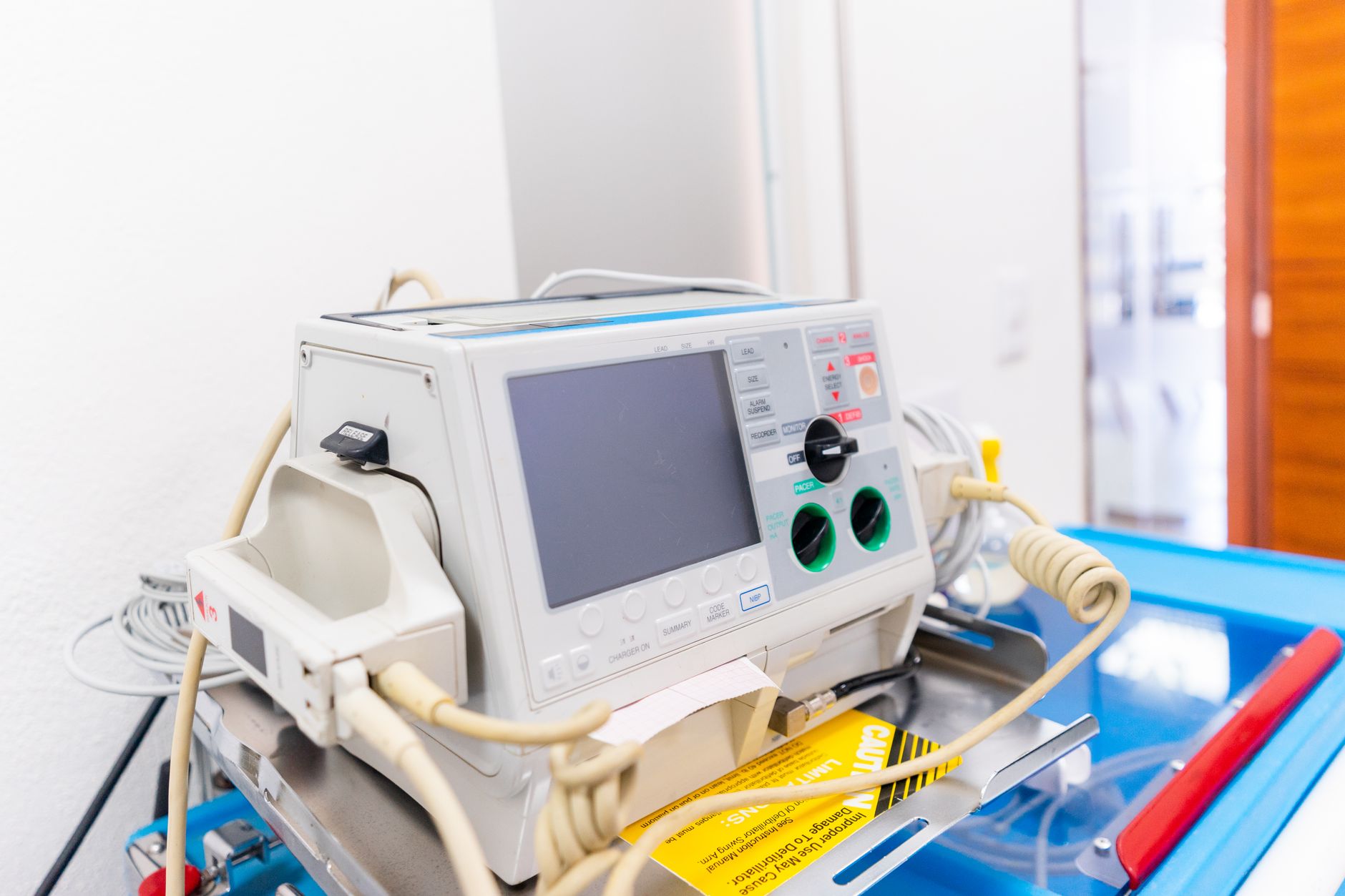
A defibrillator that fails during a cardiac emergency is usually an ordinary negligence case against whoever was supposed to maintain it, not a gross negligence case against the person who grabbed it off the wall. Gross negligence enters the picture only when someone knew the device or the response plan was deficient and used it anyway, or ignored a known duty to act — and that distinction is written directly into the law that shields AED rescuers from liability.
An AED, or automated external defibrillator, is the portable shock box found in gyms, airports, schools and office lobbies. Federal law immunizes the untrained bystander who uses one. It does not immunize the business that bought it, hung it on a wall, and never tested it again.
Table of Contents
- Where the law draws the line between negligence and gross negligence
- The owner of the device is held to a different standard than the rescuer
- The controlling standard is your state's AED statute
- What Dawkins decided, and what it did not
- Device failure as a product claim, not just a negligence claim
- Practical steps if a defibrillator failed during an emergency
- Frequently Asked Questions
Where the law draws the line between negligence and gross negligence
The federal Cardiac Arrest Survival Act sets the dividing line explicitly. Under 42 U.S.C. § 238q as published by Cornell's Legal Information Institute, a person who uses or attempts to use an AED in a perceived emergency is immune from civil liability — unless the harm was caused by willful or criminal misconduct, gross negligence, reckless misconduct, or conscious, flagrant indifference to the victim's rights or safety. That phrasing matters for anyone evaluating a claim.
Ordinary negligence by a rescuer is not actionable at all in an AED case. Gross negligence is not a bigger version of the same claim; it is the only version that survives the immunity. Courts generally describe gross negligence as a conscious disregard of a known risk, as opposed to a careless mistake. Fumbling the pad placement under pressure is a mistake. Knowing the unit had been flagged as defective and telling staff to keep using it without a backup is the kind of conduct that reaches the higher standard.
The owner of the device is held to a different standard than the rescuer
The same statute separates the rescuer from the acquirer. Section 238q(b)(2) withholds immunity from the entity that acquired the AED when the harm flows from that entity's own failure to properly maintain and test the device, to notify local emergency personnel of its placement, or to train its employees. Those are ordinary negligence duties, and they are where most defibrillator-failure cases actually live.
This is why maintenance records, not rescuer conduct, are the usual pivot. The questions that decide the case are mundane and documentary: A plaintiff who can show the pads were years past their expiration date has a negligence claim against the facility without ever arguing gross negligence. A plaintiff who can show the facility received a recall notice and filed it away is building toward the higher standard.
- Were the self-test logs kept, and who signed them?
- When were the pads and battery last replaced, and had either expired?
- Was the unit registered with local EMS?
- Which employees were trained, and when did the training lapse?
- Did the owner receive a manufacturer field safety notice, and what did it do about it?
The controlling standard is your state's AED statute
Federal law is the frame, not the rule. Section 238q creates no cause of action, and it supersedes state law only where a state lacks comparable immunity. In practice, every state has its own AED statute, so the operative standard in a specific case is that state's — and the state wording is often different from the federal list.
Illinois is the clearest illustration. Its Physical Fitness Facility Medical Emergency Preparedness Act bars any right of action over AED use or non-use at a covered facility except for willful or wanton misconduct, and it conditions that shield on the facility actually meeting its plan, equipment and maintenance requirements. The Illinois General Assembly's text of the Act ties the immunity to compliance, which means a maintenance failure can cost a gym the protection outright. So before anyone argues about degrees of negligence, the first research task is the state statute: which entities it covers, what standard it names, and whether the immunity is conditional on compliance.
What Dawkins decided, and what it did not
In *Dawkins v. Fitness International, LLC*, the Illinois Supreme Court addressed a patron who collapsed and was pulseless at an Oswego fitness club while a trained employee and an on-site AED went unused. The opinion, filed May 19, 2022 and reported by Justia held that a covered facility owes a statutory duty regarding AED use where non-use would amount to willful and wanton misconduct. The limitation is as important as the holding.
The case arrived on a section 2-619(a)(9) motion to dismiss, so the court held only that the plaintiff could conceivably prove willful and wanton conduct. It expressly did not reach the merits. *Dawkins* establishes that such a claim can be pleaded and proceed in Illinois; it does not establish that such claims win. Read correctly, the case is a survival-of-the-pleadings precedent. Anyone citing it as proof that a gym is liable for an unused AED is overreading it.
Device failure as a product claim, not just a negligence claim
Sometimes the device itself is the defendant. Failures of this kind are documented in the agency reporting system: a study of FDA adverse-event reports published in *Annals of Emergency Medicine* in 2011 counted 524 AEDs that failed to deliver a recommended shock, 252 that failed to complete rhythm analysis, 37 that never powered on, and 110 that powered off unexpectedly. The authors concluded that conditions undetected by routine self-test can cause units to power off and delay defibrillation — which undercuts any defense resting on a clean self-test log. Recalls supply concrete hooks. FDA listed a Class 2 recall for HeartSine samaritan PAD devices, numbered Z-0288-2026, initiated September 18, 2025 and posted October 23, 2025, covering units where an improperly seated Pad-Pak or bent locator pins can cause the device to repeatedly request pads, fail to power on, or fail to deliver the intended therapy. Stryker publishes these notices on the HeartSine field safety notices page.
Recall language can also cut against a recklessness theory. A separate HeartSine Class 2 recall, Z-2174-2025, initiated June 30, 2025, covered specific serial-number batches, and Stryker's notice said internal testing put the probability of failure as low and advised keeping devices in service pending replacement where no alternative AED was available. A facility that followed that instruction was doing what the manufacturer told it to do. The regulatory posture helps the product theory. FDA's final order of January 29, 2015, republished at 80 FR 4783 on February 3, 2015, kept AED systems in Class III and required premarket approval, following a January 25, 2011 advisory panel majority that recommended the PMA pathway. A failed AED therefore sits under the agency's strictest device route, which is useful context for a design or manufacturing defect claim alongside any negligence count.
Practical steps if a defibrillator failed during an emergency
Evidence in these cases degrades quickly, and most of it is in someone else's custody. The device itself stores event data, and a facility that returns it to the manufacturer may put it beyond reach.
The practical answer to the title question is that conduct rises to gross negligence when there is a documented warning that someone disregarded. A recall notice received and ignored, an expired pad set flagged on a log and left in place, or a trained employee who stood by a working device — those are the fact patterns that clear the statutory bar. A single human error during a chaotic resuscitation almost never does.
- Identify the exact make, model and serial number, and check it against the manufacturer's field safety notices and the FDA recall database.
- Send a preservation letter early covering the unit, its pads and battery, its internal event log, maintenance and self-test records, and any staff training rosters.
- Request the EMS run report and the 911 audio, which fix the timeline of when the AED was retrieved and when a shock was or was not delivered.
- Ask whether the facility was a covered entity under the state AED statute, since coverage drives which standard applies.
- Separate the two defendants in your own analysis: the owner's maintenance duty is ordinary negligence, while a rescuer claim must clear gross negligence or the state equivalent.
Frequently Asked Questions
Can I sue the bystander who used the AED on my family member?
Almost never. Federal law and every state AED statute immunize a good-faith rescuer, and only willful misconduct, gross negligence, reckless misconduct or conscious indifference strips that protection.
Does a recall automatically mean the manufacturer is liable?
No. A recall is strong evidence of a defect, but you still have to connect that specific defect to the specific failure. Some notices, like Stryker's June 2025 HeartSine letter, advise keeping units in service, which complicates a claim that continued use was unreasonable.
What if the AED worked but nobody used it?
That is a non-use claim against the facility, and in Illinois it must be pleaded as willful and wanton misconduct under the standard the Supreme Court applied in *Dawkins*. Other states word the standard differently.
The self-test light was green. Does that end the case?
Not necessarily. The *Annals of Emergency Medicine* analysis of FDA reports found conditions undetected by routine self-test can still cause a unit to power off or fail to shock.
You Might Also Like
- A Pacemaker Recall Affecting Dependent Patients: Does the Conduct Rise From Negligence to Gross Negligence?
- A Hernia Mesh Implant Followed by Revision Surgery: Does the Conduct Rise From Negligence to Gross Negligence?
- Cases Remanded From an MDL for Individual Trials: How Would a Settlement Matrix Value Different Claims?